Twilight Of The Dogs news story on Prince George's County Community Television June 10, 1993
It was the morning of Thursday June 10th 1993 when we were visited by PG County Community Television to do a news story on Twilight Of The Dogs. It was our 9th day of shooting, there would be 30 more days to go after this (including 3 days in mid-May of 1994, to "pick-up" shots/sequences we missed).
My friend, the Commissioner of Film for PG County, Gailyn Gwin, interviewed me and did the onscreen report when it aired. Another friend of mine, Paul Crosariol, was the cameraman.
Although Gailyn reports Invader to be my first film, it was my second following Star Quest: Beyond The Rising Moon, Twilight being the third.
The next day (after this was shot) we welcomed Hollywood's Alicia Craft as our new Directory of Photography (Cinematographer), who did an amazing job on the film.
Gailyn also kindly provided us with all the footage they shot for the news story, a lot of it unique, which we will be using in parts of the documentaries which will be included on the BluRay and DVD release of Twilight Of The Dogs in a few months.
See you in 2 weeks, and hope you enjoy the video!
John Ellis Hollywood, CA
-30-
(NOTE that if receiving this in email, to view the video you have to click on the link to visit the blog, and/or click on this YouTube link: https://youtu.be/fmG9PFDu3Ko
This article was written as a bit of a tongue-in-cheek promotional piece by Tim Sullivan, 27 years ago for Monster Maker Journal magazine, which appealed to fans of effects-makeup, monsters, and, well...gory makeup effects. So be prepared when you read article that some of it exaggerates: there is NO pus in the film, and also many of Tim's descriptions benefit from the reader's imaginations. More after the articles...
Monster Maker Journal #2 - July 1995
Monster Maker Journal film preview...
Twilight Time
by Tim Sullivan
The cast, crew and cow of Twilight Of The Dogs. There's a Russian tank in the picture somewhere.
It is possible that Olympia Filmworks International / The Very Big Motion Picture Corporation of America is the most successful production company in the Mid-Atlantic States? Who knows for sure, but Olympia has stayed in business for nearly a decade under one name or another (Common Man Films was the original moniker). That's quite an accomplishment in the world of independent film-making. What's even more significant is the firm has made two films -- Star Quest: Beyond The Rising Moon and Invader, both released to home video by VidAmerica and TriMark, respectively. Producer/Director John Ellis is putting the finishing touches on Twilight Of The Dogs, a science fiction epic shot skillfully on a shoestring budget in rural Maryland.
Following the worldwide success of Invader, Ellis decided to do something a little different. He asked your humble servant to come up with a screenplay that would be more character-oriented than his previous efforts, while not skimping on the special effects and monsters.
The adventures of Stealth pilot Sam Asgarde and the half alien woman Karuy, after the collapse of civilization, provided the eventful context. Their world, first seen from space over the opening titles, is a dusty overheated ruin inhabited by genetically engineered spiders the size of George Foreman. This unfortunate situation has been caused principally by the spread of a sexually transmitted disease that eats away human flesh. It's the custom to throw yourself down into a spider pit when you know you're rotting away from the plague, huge oozing sores being the telltale symptom.
In one of the few habitable regions left after the major cities have been nuked in an unsuccessful attempt to contain the disease, a deranged ex televangelist has organized some survivors into a paramilitary church, where he exerts his will on the wandering bands of starved nomad “dogs” remaining after the agonizing holocaust. (Not to mention having his way with the nubile young chickies.) This is where Sam Asgarde comes in -- of course -- and he soon gets to first base with his gorgeous, if extraterrestrial, girlfriend, while reluctantly battling evil. Their clash with the good Reverend sparks the gory goings on. Aside from various explosions, bullet hits, dismemberments, etc., Twilights effects range from 27th degree burn victims to panoramas of ruined cities. But let's start with the fun stuff. The gore.
Left: actor Ralph Bluemke shows off the unpainted burned flesh appliance
surrounded by the generic blister appliances. Right: the finished
makeup.
The man responsible for the blood and pus is Twilight's makeup maestro Tim Davis (see sidebar). Tim is incredibly enough, also the editor of this magazine! Is there no end to this Renaissance man's talents? His film and TV credits include New Jack City (Warner Brothers), and America's Most Wanted (Fox). All seriousness aside for just one moment, Tim came up with some masterful appliances, displaying the rotting flesh and dangling eyeballs of plague infected zombies and radiation victims with panache. You'll love the shot where a guy pukes into his own open sore!
Another cool shot shows a loser getting his brains blown out. In fact, that happens more than once in the picture, but Tim's piece de repugnance has to be at the film's climax when a dude is roasted alive. In closeups, you can see so much grizzly detail underneath the suppurating pustules that you might even hesitate to gnaw a kernel of popcorn for a nanosecond or two. I mean this guy is toasted! Add to that the odd crucifixion victim or mutilated corpse, and you can see that Mr. Davis was a busy man on the picture. Monster Maker Journal was probably behind schedule for a while as a result. Sorry.
Stop motion was used to bring the giant black widow spiders to creeping life in the desolate world of the future. The arachnids were constructed and animated by Kent Burton, whose work can be seen in such mainstream productions as Ed Wood (Hollywood Pictures), Naked Gun 33 1/3: The Final insult (Paramount) and Freaked (20th Century Fox), as well as independent features like Metamorphosis: The Alien Factor. Kent used mattes as well as miniature sets to blend the spiders with live backgrounds and make them interact with humans and animals. The giant arachnids kill a dog and a number of humans. His animation, honed on MTV spots, music videos, and Land Of The Lost episodes, is as smooth as Ray Harryhausen. You know, that 50s and '60s monster guy who won a special Oscar a few years ago presented by no less a figure than Tom Hanks.
Stop motion animator Kent Burton manipulates a 1/6 scale genetically
altered giant black widow spider in its “spider pit” lair. (note
animation gauges)
In fact, this is the first picture Kent's worked on in his own home FX shop, which he built in Southern California in 1994 and dubbed Hesperia Studios. Employing a beam-splitter, Kent's front projection technique is flawless. The final effect has had preview audiences jumping at test screenings. You know how it is when a deadly, poisonous, 150 lb spider comes down off the ceiling right at you? As Bob Hope said in Ghostbreakers (1940), reminds me of my hotel room in Scranton. Insect fear fans will eat it up with a spoon.
The guy pulling all of the fun together is producer-director John Ellis, who performs miracles on extremely limited budgets. I've hung around plenty of movie locations but I've never had the pleasure of working with a man who can do so many things so well on a set. John has drawn storyboards, painted sets, designed effects sequences, blown up miniatures, painted and animated optical animation cels -- you name it -- as well as putting the actors through their paces. This is nothing new to him as he has been producing high quality special effects and live action work as an industry professional since 1979. John has created effects laden promos for just about everybody in television, and his designs helped kick off the fledgling MTV Network in the early 80s. Along the way John learned how to create opticals from scratch. For the energy bolts fired from Karuy’s dysjuncter gun, he used 35mm filmed live backgrounds, drew the bolts on tracing paper over the projected frames, painted cells by hand using the tracings as templates, and photographed the cels laid over the original action on an optical printer at the Bill Dempsey’s studio in Washington, DC, a suburban of North Arlington. The cels are lit with a blue gel to complete the process. Time consuming, but a terrific effect. Like I said this guy can do just about anything.
Twilight Of The Dogs director John Ellis demands some Gatorade while waiting for the next setup.
As a cast member, I can tell you that John is definitely an actor's director. He empathizes with the characters as if he were a thespian himself, comprehends actors problems, and gives the performer as many takes as he or she needs to get the scene across. This is pretty unusual in independent, action, SF and horror films, but John knocked himself out to supervise every aspect of the production, and to furnish Twilight with the highest quality inhumanly possible.
And speaking of production values, that brings us to Ron Miller's matte paintings. Ron is a space artist whose work has been seen in Dune and Total Recall. His magnificent paintings for Twilight Of The Dogs give a sense of scope to this futuristic horror tale. Excellent miniatures were built by Norman Gagnon, Lee Stringer and Mike McGee, only to be destroyed by Karuy’s dysjuncter gun in the film, a prop also built by Gagnon. Adding further realism is the flashy work of former Navy SEAL chief Walter “Boom Boom” Suarez (that's Mister “Boom” to you), pyrotechnics expert and armorer par excellence. Perhaps the most difficult explosion was the destruction of the Reverend's Soviet Armored Personnel Carrier, a Russian tank reportedly captured in Operation Desert Storm that seats 11 of his “deacons”, complete with firing turret Cannon and blazing AK-47s at the gun ports. In the course of shooting, Walter blew up what seemed to be half of the Maryland countryside.
Local folks didn't mind a bit. Dozens of them came on the show as extras, and the Upper Marlboro Volunteer Fire Department provided invaluable assistance. A few miles from a vast gravel quarry in Laurel, sets were constructed in the old Marlboro tobacco refinery, where livestock used in the film were also housed. A black stallion (who's shot out from underneath Sam Asgarde during a skirmish with the titular “dogs”), assorted rats, and the spider-bitten canine TEX were owned and trained by wranglers Doug Sloane and his partner Billy “Butch” Frank, two cowpokes who’d worked on TNT's Gettysburg with Martin Sheen, Jeff Daniels, and the late Richard Jordan; on Sommersby with Jodie Foster and Richard Gere; and on the civil war feature Glory with Morgan Freeman, Denzel Washington, and Matthew Broderick.
Author and star of Twilight Of The Dogs, Tim Sullivan as the reluctant hero, Sam Asgarde.
My own credits are somewhat more humble. Before writing the screenplay and co-starring with the beautiful Gage Sheridan in Twilight Of The Dogs, I'd written seven science fiction novels including The Parasite War, Destiny's End, The Martian Viking, and Lords Of Creation, edited two horror anthologies (Tropical Chills, Cold Shocks), published 30 odd short stories and hundreds of articles, served as creative consultant on the Hemdale feature In A Moment Of Passion, starred in the horror film The Laughing Dead, and generally made a nuisance of myself for the past 15 years or so in the world of horror and SF. A project in current development is Knucklebones, based on my own 1988 short story, the story of a 12-year-old serial killer. Should be plenty of intestines in that one. Love them nurnies! That picture will be shot at Morro Bay, California, this fall, and it is slated to be directed by Richard Marks for Aspen Pictures.
John Ellis and I came up with the original story for Twilight, which incorporates sci-fi and horror ideas in a future setting we were certain we could realize. Lacking a large budget, we were determined to make every dollar show on the screen, first with a strong story featuring genuine characters and then with the production values necessary to get it all across, with maximum impact. Principal photography in the mosquito-infested summer of 93 -- the hottest in 50 years -- was plagued with many problems, so it was necessary to return to our locations in the spring of ’94 to shoot pick-ups -- these went without a hitch, and post-production began, nearly a year ago as I write this.
One of the giant black widow spiders on the miniature desert set…
That's okay though. This may be independent, action-oriented, Horror/SF, but it ain't exploitation. The extra time we put into this picture should make it worthwhile viewing not just for typical mainstream audiences or blasé videophiles; creature fans in particular should have a good time. I know I did. I got to fight monsters, kill bad guy fanatics, kiss pretty girls, ride horses shoot off automatic weapons, and generally comport myself like a barbarian on Saturday night.
Whether or not my enthusiasm comes across on the screen isn't for me to judge, of course, but the finished film came out great. Twilight isn't quite like anything you've seen, and it's quite a roller coaster ride. It's well directed, beautifully shot by Alicia Sehring (Star Trek The Next Generation), the violence is intense, and the effects top notch. And, present company excluded, I can vouch for the cast. Ralph Bluemke as the evil Reverend Zerk, is a standout, as is the superfine Gage Sheridan, as the gorgeous female alien warrior, Karuy. In supporting roles Ellen Hart and Barry Sigismondi are excellent. Tex the dog, Diablo the horse, and Gertrude the cow are expert scene stealers. Only the cow survives by the way. The indefatigable George Stover cameos as one of the reverend's more accommodating acolytes. As Sam Asgarde, Tim Sullivan sweats a lot. Ozone layer depletion, you see.
Stuntman Phil Hayes does a full burn while doubling for actor Ralph
Bluemke. Phil is a trained professional and all possible safety
precautions were taken on the set.
Oh, and the director's hands are shown in one scene, gashing the leading lady with a knife, giving Tim Davis one more opportunity to get out the old blood tube for one last red spurt. But I refused to tell you anything more about Twilight Of The Dogs. I will guarantee you a good time, so go out and rent it. Your bucks will surely make Olympia Filmworks the most successful production company in the region, if it isn't already.
Oh, I did mention the buckets of pus on the guy who's been torched, right? Right, I thought so...
See you soon at the old Schlockbuster, fellow video monster lovers.
Makeup artist and Monster Maker Journal editor Tim Davis applies cuts and bruises on actress Gage Sheridan.
About My Work On Twilight Of The Dogs
by Tim Davis
Actress Ellen Hart had to get this heavy “dirt” makeup every day! There's no soap in the future!
Twilight Of The Dogs was an interesting shoot to say the least. The first stage in preparing the makeup effects starts with the script reading at the director's apartment with the heads of each department present. Once I had my script, I noted each scene that required special makeup and effects. The director made some special suggestions, then it was time to buy supplies. The time between the first script reading and being on the set and ready was only one week! The script really didn't require major prosthetics but it did need lots of diseased people so I picked Gel-Fex to create the ugly ulcerations needed. The problem with Gel-Fex is if it gets too hot, it melts. While shooting on location we experienced the hottest summer on record for the area plus shooting in a desert-like quarry didn't help either. I applied a huge mass of blisters on the stomach of MMJ reader and movie extra Jeff Prettyman and in the 90 plus degrees, it just melted right off him in less than 10 minutes.
There were two makeups that required detailed prosthetics and with no lab time I turned to friend and expert effects artist Robert Beach (now living in California). He gave me a few foam appliances made for science fiction convention costume contests (he regularly won!) and I adapted and applied them on the set for the horribly burned Reverend Zerk and a nuclear fallout victim who shows off what he had for lunch. These makeups benefited from Robert's detailed sculpting and casting skills.
Ted Woynicz as radiation victim, makeup by Tim Davis.
The hordes of ragtag survivors (scavenger dogs) required lots of dirty faces and hands, and legs, and clothes, and feet… the straight makeup artist, Mary Lou Benzino and I went through at least six large jars of Texas Dirt (Max Factor) in two different shades over the 3 months of location shooting. One trick you may want to try with Texas Dirt, get your model to squint their eyes real tight then lightly brush the dirt powder over the crow's feet at the corner of their eyes. When the actor relaxes his eyes and cheeks you'll see the realistic dirty crow's feet look seen in hundreds of westerns.
Inside back cover photo: Gage Sheridan as the alien Karuy from the film Twilight Of The Dogs.
We also had to help the wardrobe department distress the dogs costumes and that included taking scissors to them and spraying them with theatrical black hairspray. A wardrobe department assistant cut a hole to over one extras cleavage, to distress her t-shirt. After a day in the blazing sun for her scene she discovered that after she washed the dirt powder off, she had a sunburned circle on her breast the exact shape of the hole. Tim Davis
Olympia Filmworks International, alas, was not to be. The trends affecting the film and home-video industries and markets at the time took their toll...and then there was the sabotage I have covered in prior posts. Although Andy Ross, Tim Sullivan, Liz Heyd and I worked diligently throughout 1995, it was terminated. Also Tim Sullivan's film Knucklebones died for lack of funds. My longtime friend Tim Davis passed away February 8, 2015 from congestive heart failure, he was 56. There will be a never-before-seen interview with Tim Davis on the BluRay for Twilight.
Work continues fixing various bits and pieces of effects shots that (as I've said here before) "have always bothered me." There are about a dozen shots left to finish at this point, and the work is being done by Peter Andrew Montgomery and myself.
Progression of steps used by Peter Andrew Montgomery for a new optical effect (described below)
Peter Andrew Montgomery explains his process:
"Tech stuff in post for John Ellis movie Twilight of the Dogs that I'm finishing up effects enhancements for. I took the original shot, reduced contrast to obtain a jet black background. I then tinted the subject green, and added colour balance, pulling red and blue to zero and boosting yet more green. After this. I added another contrast and flattened the green in the image. I now have a green subject on pure black. Now to add an inversion turning the image negative before setting to green only, this flipped the matte to a black subject and green background. After render, I took this plate and placed it on top of the original contrast reduced image of the subject, applied Keylight and removed the green screen signal, cropped the black matte and feathered. This left an outline of the woman, that outline was then blurred and turned blue in tone and leveled up to be brighter. That layer was then further rendered and placed with a super imposition back onto the woman. I finally added a light burst to create the beam effect and a further turbulent displacement to cause the beams to move. That's basically the image in non motion on black, for the composite onto the stars, the black matte with green keyed out is placed onto the back-plate image of space, and finally the woman superimposed on top of that before parenting the matte layer to her before motion was applied. John wanted a chemical look for this so no light wrap. The black rope was matted using a garbage matte of another black layer".
Here's some more examples of Peter's exceptional work:
Frame of the original effect from 1995
Peter Andrew Montgomery's new VFX
New optical effect by Peter Andrew Montgomery
New optical effect by Peter Andrew Montgomery
Matte Paintings by Ron Miller:
Famed astronomical artist Ron Miller has been involved with Twilight Of The Dogs from the beginning, for which I am forever grateful. He did a few key matte paintings for us back in 1994, and recently did another we needed for half a dozen spider shots.
The burnt brush in the background is a new replacement matte painting for 'Twilight' by Ron Miller.
Ron Miller's new painting was composited into multiple shots by Peter Andrew Montgomery. The miniature set,
spider model and stop-motion animation are by Kent Burton.
Here's a matte painting created for 'Twilight' by Ron Miller in 1994:
Matte painting of disused nuclear weapons facility from Twilight Of The Dogs by Ron Miller
I recently discovered several snapshots I took of Ron working on this paintings:
Ron Miller working on matte painting of disused nuclear weapons facility for Twilight Of The Dogs
Matte painting for Twilight Of The Dogs by Ron Miller in 1995
1995 Animation cels for 'Twilight'
In 1995 I animated several dozen optical effects shot for Twilight of the Dogs, consisting of hundreds of animation cels. They were painted black by assistants Laura Barltrop and Elizabeth Heyd, who also cut black construction paper to cover the rest of the cels, leaving clear areas for the light to pass through
I finally found ALL of the cels, which solved a number of problems, where I wanted to re-do some of those shots. The following pictures show a little of what's involved:
Under-lit animation cels created in 1995
Ellis' under-lit setup to re-photograph the animation cels in 2022, using a light-box and cell-phone.
Unfinished test frame, one of the shots being re-done by me today
There's a lot more to talk about BUT we don't want to give EVERYTHING away before 'Twilight' is released late this spring, but this is just a small part of all the work being done. Over the next few months will share processes we had to deal with in 1995, and NEW technology we've been using to update the film today, as well as MORE articles and news clips from when the film was in production in the '90s.
I've been re-posting a lot of the incredible media coverage we got at the time for the film. It was unusual (in the Washington DC area) to have a full-blown homegrown science fiction action adventure picture made there, shot on film with stunts, weapons, trained animals, explosions, and a lot of special effects, including car sized black widow spiders!
That's all for now, so see you again in two weeks!
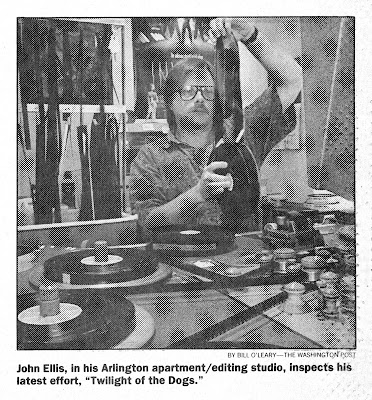
John Ellis --- film director, special effects artist and the president of Arlington's Very Big Motion Picture Corporation Of America --- is looking back on the shooting of his last science fiction movie. It was, he says, hideous. Not to mention hot, humid and mosquito-plagued. Horrible. And, nevertheless, pretty wonderful.
Ellis, 38, is sitting in a blue plastic chair, about three yards from his editing desk. Which makes it about four yards from his bedroom. The meticulously clean one-bedroom apartment serves as the Very Big Motion Picture of America office, as well as editing studio and screening room-and home for him and his significant other, Lou Benzino.
Benzino, 47, who also serves as Ellis's assistant and makeup artist, sits on the floor, making beaded earrings-"to earn some spending money," she says. She speaks rarely on this day, and almost always asks for permission before making a comment.
"There's always an affair during shooting of the movie," Ellis is saying. "This time it was our director of photography and a tank driver."
"And us," Benzino reminds him quietly.
The Sci-Fi Director
Both romances started last summer, during the shooting of Ellis's third picture, 'The Twilight of the Dogs," which should be available on home video or cable early next year. (The first two were "Beyond the Rising Moon" and "Invader," the latter of which begins airing on Cinemax tomorrow night at 9:30.) He shot it in an old tobacco house in Upper Marlboro. In fact, all of his pictures have been shot in this area.
He explains: "I live here, for one thing. And then, here I'm unusual," says Ellis, gesturing with his hand and revealing the Mickey Mouse watch on his wrist. "In Hollywood there'd be hundreds of other guys just like me, waiting in line to get the money."
Not that it's such big money. Ellis's movies have all been shot on low budgets. "Twilight," the most expensive, is expected to come in for less than $500,000. ("But they look as if they cost millions," Ellis insists.)
He finds his investors mostly through personal contacts. They are doctors, lawyers, friends---in short, "people who have a few thousand dollars to play with." And a lot of people like to gamble, Ellis declares.
"It's amazing," he says. ''You say to them, 'lt's very risky---you could lose it all,' and their eyes grow big. They say 'Oh, really?' "
But, he says, it's not really so risky---it's possible to predict pretty well what the revenues will be overseas. "And if [a movie] takes off, the sky's the limit," say Ellis. He has high hopes for "Twilight." He will send it to the Cannes Film Festival. And, he says, maybe a major distribution company will pick it up for wider release.
Ellis, who was born in Ohio, says he got his first 8mm camera when he was 14. But he got hooked on films even earlier. "I grew up on the farm," he says. "I have this vivid memory of running in the fields that were taller than I was.
...I remember that and I remember TV...Watching 'Alfred Hitchcock Presents,' 'The Twilight Zone' and some films that just scared me half to death."
And there also were "Rin-Tin-Tin" and 'The Lone Ranger." 'They show the difference between right and wrong," says Ellis. "A lot of what I'm trying to put into the films ... comes from that period ... I'm trying to set a good example."
Ellis gets his console ready for presentation of the first, incomplete version of "Twilight of the Dogs." He switches it on. Nothing happens--- the bulb has broken. Ellis the handyman dives under the console.
Finally the film starts to roll. There's still much to be done; special effects will be shot and added, the music hasn't been composed yet, and the sound seems rather artificial, but one can get some sense of what seems to be a rather eclectic story.
Ellis stops the film.
He says he makes science fiction movies because he has the right background for them. And he can create a lot of the special effects himself. "It's very easy to write in the script that you have a spaceship, and it lands, and people get out of it ... [But] how to do it, how to make it exciting and interesting ... I can bring that to films."
And the science fiction market is strong now. "A year ago," he says, "if I'd called and said, 'I have a science fiction movie,' a lot of distribution companies would have said, 'Don't call us, we'll call you.' "He suspects it's partly due to a relaxation of the world political climate. "Since the fall of the Berlin Wall, and other things, people are maybe looking more towards the future."
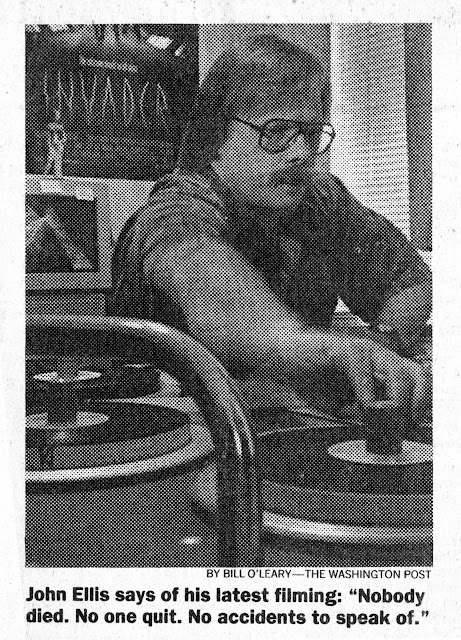
Shooting "Twilight'' took 35 days last summer. "We had a heat wave," recalls Ellis with a shudder. 'The building wasn't air-conditioned." It was so bad, he says, the actors were fainting. And there was a plague of flies and mosquitoes. "We were covered with bites," he says. But then he turns to the bright side: "Nobody died. No one quit. No accidents to speak of ... Nobody really got hurt on the film. Well, a cow stepped on [lead actor) Tim Sullivan's foot. That's no fun."
And what was fun? "I climbed to the top of a hill, to pick an angle to shoot from. And I ... saw all those people: the main actors, and all those extras and support people, a Russian tank and a trailer for the animals, all that stuff just stretching out-almost as far as I could see. I said, 'Oh my God ... I caused this to happen! That was quite a moment for me. But it was scary."
Ellis hopes this movie will put him over the top. His previous one, "Invader," was a financial success---video sales worldwide totaled $6 million- and that has made a difference. 'I have more and more people come to me, saying, 'We will get the money, we want you to make the film.' Until just a few months ago this would never have happened."
If he ever makes it big, he says, he probably would move to California. His children live, there now with his ex-wife. But "even if I do go out there, it's more than likely I would still continue to make films here," he says. "It's better to be a big fish in small pond."
But even if 'Twilight' isn't a hit, he says, "as long as I can work with nice people, have a relatively good time and have projects I relieve in---I'd be happy doing this. I try hard to make sure I don't take myself too seriously. It's· a business.
And it consumes most of his time: editing, calling, dealing with film crews and various specialists. Meanwhile, Benzino works on her earrings and answers the phone.
He works 12 hours a day, he says. At least, she interjects.
Isn't it difficult, spending so much time in this tiny apartment with dozens of strips of film hanging on the wall, with the console and the press cuttings and the posters? Doesn't it ever get claustrophobic?
For a while it seems they don't have an answer. They exchange glances, and then Ellis begins to speak about being a workaholic and not being able to imagine doing anything else, and points out that they don't stay indoors all the time---they can't shoot a picture there.
Then Benzino says she doesn't really need to go out, she feels okay at home. Finally she casts him another glance.
"The things that are making us happy," 'she says, "are right here."
-30-
Originally published Saturday December 11, 1993 in STYLE (The Arts/Television/Leisure section of The Washington Post). Photographer Bill O'Leary was a friend, one of the members of the Washington film-making group The Langley Punks, and it was a surprise to see him and chance to catch up. Actually, one of the Punks, Pat Carroll, appears in my film Invader!
To be honest, I really didn't like the article, my least-liked of all the press coverage over the years, but am presenting it for posterity. And though I wasn't fond of the article, many people at the time liked it and called me to congratulate me for its being in the Washington Post. So what do I know? Also note that Lou Benzino and I were close more than a decade before Twilight, and are still nearly 30 years later.
Here's an illustration of Lou Benzino I did in 1981, 12 years before Twilight Of The Dogs!
I'm moving posts about Twilight to every other Friday morning, to give more time to deal with the movie restoration itself, and also, Linda dislocated her hip replacement a second time in a week, and this time it was brutal, and have even more to deal with for the moment. Hopefully Friday January 28th's post will finally see the Visual Effects update I've been promising for the last few weeks, some really cool stuff! See you then!
Due to circumstances beyond my control, there's no new post this week. My domestic partner dislocated her 5
week old emergency hip replacement yesterday. It got fixed without
surgery, but MANY hours later we are both worn out from the experience, so watch for a new post next Friday at the recular time!
(This article originally only had 3 pictures with it, one each for Star Quest, Invader and Twilight Of The Dogs. More pictures have been added (the ones with bold captions), and this article has been modified slightly for accuracy and transparency. See you next year!)
John Ellis and Tim Sullivan don't let a low budget stand in the way of making silver screen magic
May 1994.
Movies by Mike Mayo
Successful low budget SF film-making is itself an act of science fiction.
The world of low-budget science fiction movies isn't an easy place to make a living. Filmmakers who choose to work in it spend much of their time trying to spin straw into gold, creating visual miracles on microscopic budgets. There's never quite enough money, and efforts to raise more are virtually constant.
John Ellis between shots on Twilight Of The Dogs.
With three films under his belt and a fourth in the planning stages, John Ellis is a low-budget veteran. When we sat down to talk about his work, he had just been sending out letters to investors in his most recent project, explaining what was happening. The fact that one of his backers had just gone into chapter 11 bankruptcy didn't make it any easier.
But then, nothing had been easy for Ellis recently. Even getting to the interview was tricky. On the day we'd arranged, there were quakes and aftershocks in California where his kids live, and painful record cold in the Washington, D.C. area had killed his car's battery. Add in an ice storm, snow, and impassable roads and you've got the interview that was not meant to be.
But we persevered and managed to find a restaurant we could both reach near the pentagon, an institution that Ellis had taken some liberties with in his most recent release, Invader.
But that's getting ahead of the story. His interest in science fiction films had, he admitted, a curious beginning - When Dinosaurs Ruled The Earth. When that venerable Hammer B-movie was first released (in 1970), he saw it five times in 5 days. But it wasn't the leather bikinis that caught his interest; it was Jim Danforth’s stop-motion special effects.
Ellis went straight home and made a Tyrannosaurus rex out of metal and foam rubber. Today, he's 30-something, with long red hair and beard, and an earring dangling from his left lobe. And he still loves good special effects and science fiction.
After his T-rex, he said, “I started as an illustrator, sold my first freelance piece of artwork in 1970, did a lot of Science News Magazine cover artwork. That led to work in commercial television in Washington, D.C.
Science News Magazine cover by Ellis, September 22, 1979.
“I did stuff for armed forces, network tv, shoes and toothpaste commercials, vacuum cleaners, both at Broadcast Arts and Taylor Made Images, both defunct now, sometimes as a flunky, sometimes the driving force.” The work involved animation, special effects and live action, and it gave him the skills he needed to consider moving into feature-length projects.
“When you're doing commercials, you get a sense of presentation because there is a product that is being sold - whether goods and services or a concept - and you learn to present it in a way that the audience identifies with it instantly. Sometimes you want somebody to say ‘What's that?’, but usually you want people to get it instantly.”
John Ellis at Broadcast Arts, animating part of a TV commercial for Baltimore's WMAR radio in 1984.
In 1982, he and his associate Phil Cook decided to take the plunge. In Baltimore, they'd seen and worked on the ultra-low budget films Nightbeast and Galaxy Invader for Don Dohler and thought they could do better. "We both knew that we had the raw talent to do it. As an illustrator I knew I could design and make any props.”
In Star Quest: Beyond The Rising Moon, this elaborate miniature set designed by John Poreda is an atmosphere processing station on the poisonous planet Inisfree.
Their first effort together was Star Quest which Cook wrote and directed and Ellis produced. “There was a total envelope on that film,” he said. “The whole look of it was put together by Phil Cook, myself and John Poreda, who did the majority of the design work. That film was pretty much Phil's vision. It was his original story, but we were feeling our way.
One of the bigger sets on Star Quest.
“It was a combination of special effects to establish locations and clever lighting to interconnect our sets with the miniature effects. We tried to root it in reality. Whether we succeeded or not is not for me to say.”
Actually, they did pretty well. Science fiction readers will catch the influences of Robert Heinlein's Friday and Frederick Pohl’s Heechee novels in the story of Pentan (Tracy Davis), a genetically engineered hit woman who rebels against her corporate owners and searches for the wreck of an alien spacecraft.
Star Quest (originally titled Beyond The Rising Moon) early sales poster, art by John Poreda.
The film was made in Northern Virginia. Live action scenes were done in a concrete tunnel at the Pentagon and on an interstate highway overpass. A barren field near the small town of Culpeper became the planet Elysium. But the most memorable moments were created in a 40-by-45-ft corner of a warehouse, where the sets were constructed and the special effects were photographed in Alexandria, Virginia.
Ellis and Cook used every trick they could come up with to save money (on a $152,000 budget). They scavenged lumber from a nearby dumpster to build their sets, and since they shared the warehouse with a juice distributor, the place stank of fetid oranges.
Star Quest in Japan (home video cover) 1989.
Despite those handicaps, they got what they were after in visual terms. The interplanetary and aerial sequences look good. They move quickly without obvious trickery. The sound dubbing isn't as successful. Too often the voices sound like they come from a dubious Italian import.
Still, Star Quest does enough things right that Ellis and Cook screened a 35mm print at the Cannes film festival. From that, they got a fair review in Variety and made a smattering of sales. The special effects work they did on the film was described in detail in the May 1990 issue of Cinefantastique, and in the September 1989 issue of American Cinematographer.
More importantly, Star Quest also got them in touch with people working in the distribution end of the business. They put together another film package, but couldn't find studio backing for it.
In John Ellis's film, Invader, big Harvey is a 50 ft tall alien robot designed by John Poreda.
Again, Ellis anAgain, Ellis and Cook decided to do it on their own. Though the project began with the title The Killing Edge, it finally became Invader. Reminiscent of a good 1950s B-movie, it's an imaginative story of UFOs and military cover-ups that's told with humor and some terrific stop-motion effects involving a robot called Big Harvey.
But their money problems wouldn't go away. They lost an investor in the stock market crash, and it took a last- minute infusion of cash from legendary low-budget movie producer Menahem Golan to finish the film. Given the reality of the home video market, where Invader made its debut in this country, they had to approach it differently.
“Phil and I wanted to make Star Quest entertaining but not offensive,” Ellis explained, “so it's pretty tame, PG or whatever. With Invader, the word came down that it was supposed to be R-rated. That would improve the money we made from it. So we put a lot of [strong] language in it. One guy gets shot in the Pentagon cafeteria and you actually see blood squirting out.”
John Cooke, Hans Bachmann and A. Thomas Smith Smith in Invader.
The language and violence still are mild compared to many contemporary videos, and the films restraint did nothing to hurt it in the marketplace. Ellis said that Vidmark “sold 32,000 cassettes right out of the gate when they'd been expecting a demand for something like 12,000 tapes.
After Invader, Ellis and Cook thought it would be easier to get money to make another film, but once again found that was not the case. According to Ellis, the rules had been changing: “They say, now you have to make three films to be taken seriously in Hollywood.” So, they started out on their third film again spinning straw into gold from individual investors. But as they were beginning to put the film together, the industry's most famous bugaboo, “creative differences,” cropped up, and Ellis and Cook decided to work on separate projects. Ellis then found himself filling the role of both producer and director on Twilight Of The Dogs.
Line Producer Zaneta McGaha and Director Jhn Ellis going over production schedule for scenes coming up for the next few days
The two jobs don't really compliment each other. “They’re two different hats,” Ellis said, “and they can conflict. The producer runs the show as far as money and setting it up until the director walks onto the set. The producer can be a bastard; the director can't be. When I yell at people on the set as director, they know I'm not mad. I'm just trying to get everything energized. The director can't afford to be a bad guy.”
In both roles, “you've got to juggle the money and juggle the people to get the movie made.”
In the world of low-budget film-making, those juggling acts are never easy. On the basic nuts-and-bolts level of daily work, Ellis expressed complete admiration for and dependence on the other people who do so much to make a movie happen but never get credit. The craft services person, for example, who makes sure that cold soft drinks and coffee are there when needed. And the first assistant director, who serves as a sort of Sergeant, making sure that things get done.
Switching hats to 1st Assistant Director, Zaneta McGaha on set after the dangerous "full-body burn" fire stunt was safely completed, with Phil Hayes who performed the stunt
Ellis stressed how important that job is. “The first assistant directors set the pace during the shooting. They need to control everybody and not let people know they’re controlling them. It's not about directing; it's about organization.”
The hyphenated “producer-director” may sound impressive, but Ellis laughs at the stereotypes. “People think that the work involves posing and saying ‘action,’ then somebody's rolling the camera and somebody's putting the thing out there” - he makes the motion of a clapperboard with his hands- “and the actors say their lines and you paste it all together and people start wheelbarrowing money up to your front door. It's really not like that.”
With Twilight, the process began with a script written by Tim Sullivan (who also stars} for a “science fiction allegory and post-apocalypse adventure” with references to AIDS and cult religions. Ellis then worked out the logistics and shooting schedule and started raising funds.
Line Producer Zaneta McGaha, Production Nurse Joy Northam and Director John Ellis going over safety plans for the fire stunt and other fire sequences.
The comparison Ellis makes is to a train. “Once the camera starts rolling on the first day, you're on a locomotive that's going someplace and you don't know where it's going to end up. Every day you're spending money. Inexorably, it's moving forward and after a certain point there's nothing you can do to stop it. You hope that the money's there and that the people are committed enough to you that they stay even if the money runs out.
“You have to shoot, and you have to shoot as fast as possible. You're spending money; you've got people with diverse points of view, weather, other variables. If you can plan everything down to the last little detail, that's great, but it's not always possible on low-budget science fiction. Obviously you have to have planned makeup, costumes, sets, etc., But there are certain things you just can't plan for, that you don't have the time and money to plan for.”
Certain things like bugs.
1st Assistant Camera Gary Waxler (L) and actor Barry Sigismondi in the big sometimes mosquito-infested cathedral set.
One of the buildings they filmed Twilight in turned out to be infested with mosquitoes and it almost crippled the production. “I’ve still got some scars on my legs,” Ellis said, “and so do others from the cast and crew. Swarms and swarms of mosquitoes would get into the building. Those bugs nearly drove us mad! You'd have tons of jungle juice on you and they were landing all over you. It was hideous.”
That phase of production is over. By January, almost all of the photography had been done. Ellis was editing the film at his place in a upscale apartment complex behind a majestically frozen fountain. He lives with a minimal amount of furniture in rooms that are dominated by professional film equipment. One corner of the living room is filled with stacks of video cassettes and promotional material. VCRs and a laser disc player sit directly on the wall to wall carpet.
Assistant To Producer Liz Heyd in the office/editing area (Mid-1994).
A wide editing table is set up in his den. Within easy reach behind it are an Apple computer and fax machine. They’re flanked by racks holding strips of film ready to be edited. On his left is a set of industrial metal shelves holding heavy reels of 16mm film and tape. That's where he's putting the film together, frame by frame, shot by shot.
Maybe this isn't as bad as the mosquitoes, but it's just as tough. It's the real work, and after more than a year on the material, Ellis is so close to the story that he has no idea how good or bad it is. First he has to put together a rough cut about 2 hours long. That will be trimmed down to 100 minutes, and, he added, the special effects still have to be done.
John Ellis editing Twilight Of The Dogs (mid-1994).
“For the first time, we'll be using computer technology for special effects from Silicon Graphics. We also have big spiders in the film. From leg tip to leg tip when standing, they’re are about 5 feet wide and 4 ft tall; black widows that are nasty. There stop - motion animation by Kent Burton who did Big Harvey.”
Liz Heyd doubles for lead actress Gage Sheridan, originally shot May 21 1994. Though it's taken 27 years, digital effects are finally being added to 'Twilight' by Peter Andrew Montgomery.
Despite the rocky road that Twilight has traveled so far, Ellis is optimistic about its future, certainly on home video and perhaps even theaters. “I’m hoping that we can get an art house situation at least and maybe a regional release on it. We shot in a widescreen format so it could go into theaters. If it's anything like I imagine it to be, I think it would have the potential for that. It's such an odd bird.
“First and foremost, I wanted to make a good science fiction film, a film that people who read science fiction and people who watch science fiction on television and movies would look at and say, “This film has ideas. It has a different feel, a different psychology behind it.’ I like the mixture of the unknown and the nature of the universe and the nature of life and the eternal questions, why are we here, how are we here?
“The best science fiction-and there isn't much-challenges you and makes you think. When it's done well, you go to a totally different place, sometimes a different time, and it's not boring. When it's done well.”
And that's the catch-doing it well. Right now, Twilight is so rough and unfinished that it's impossible to say if it's done well. In it's finished form, it could be spun gold; it could be something less. But then, that's the risk that every filmmaker from Steven Spielberg to John Ellis runs with every movie.
Viewers will let him know how he did.
###
Sidebar:
TIM SULLIVAN: SF WRITER AND MOVIE MOGUL
Author/actor Tim Sullivan decks Randall Shepherd in Twilight Of The Dogs.
by Mike Mayo
TIM SULLIVAN LEADS A DOUBLE LIFE
Most science fiction fans know him only as a writer and editor. This makes sense, for in his 15 years as a professional in the print genres, he has been a visible presence, turning out seven well-received novels, including The Parasite War and Martian Viking, 30 short stories, and such theme anthologies as Tropical Chills and Cold Shocks.
The Martian Viking by Tim Sullivan (1991).
But thanks to fellow SF writer S.P. Somtow, Sullivan has also found a second career as actor and screenwriter. Somtow, who himself has second careers as composer and filmmaker, put together a horror film titled The Laughing Dead. The movie, which featured Sullivan's acting debut as a maniacal priest, developed a cult following dueto the appearance of many SF luminaries. Aside from Sullivan, the film contained authors such as Ed Bryant, David Bischoff and Tim Powers whose characters were all fiendishly murdered.
Tim Sullivan as Father O'Sullivan in The Laughing Dead (1990).
“I owe it all to Somtow in a way”, said Sullivan. “I’d done a little acting years ago. He called me up one day in ’88 or ’89 when I was living in Philadelphia. He said I want you to star in this movie. Somtow kept calling me. I thought he'd gone completely insane.”
After his role in The Laughing Dead, Sullivan remained in California not only because he'd been bitten by the acting bug, but because “on the pay I got, I couldn't afford to come back east so I stayed out here. My next film was called Angel Of Passion. I played a wealthy geek, a stupid rich guy whose girlfriend runs off with a muscle man. This was in ’90 or ’91. It was not a very rewarding experience. I've never actually seen the whole film. It's got a lot of breasts in it. Not mine, though.
“I then did a rewrite on a picture called In A Moment Of Passion, directed by the Zbigniev Kaminski. It was a suspense thriller and had Maxwell Caulfield, Jeff Conaway, and Martin Sheen's brother, Joe Estevez. Then I sold a script called Without A Thought. It's a suspense thriller about a woman torn between two guys, one of who's a good cop and one of who's a murderer. This was ’89. I never got paid. If any one of you readers would like to finance it....
“Then I was mucking about over at Disney, but it didn't work out. Most of my history in film is things that didn't work out. I tried to sell them a couple of different premises, one of which was based on my novel The Parasite War. There was some interest from Stuart Gordon on that, but not enough.”
Tim Sullivan as Sam Asgarde in Twilight Of The Dogs.
Sullivan's film career turned around when he ran into John Ellis, whom he knew from SF fandom from the days when he had lived in Washington DC. “He was kind of on the outs with his partner,” said Sullivan, “and we talked about doing something, and after many long phone conversations about Mad Max, David Koresh, mutated spiders and alien super-science, we actually ended up doing it! I'm not too interested in going to 20th Century Fox and going through all the horror shows you've heard about. I'd rather work on the independent level. I just did a low-budget production of A Midsummer's Night Dream, called S.P. Somtow's "Ill Met By Moonlight", It's got Timothy Bottoms in it. I play Oberon as sort of a homeless version of Dracula. There's a lot of gothic punk to it. The pair of lovers are not a pair of ancient Athenians, they're really LA street punks, and then these supernatural creatures show up, Oberon and Titania. They're sort of homeless people, but they have this mystical quality to them.
Tim Sullivan as Oberon in Ill Met By Moonlight (1994).
Even though Twilight Of The Dogs may mark Sullivan's big break he hasn't turned his back on fiction. I'm still writing prose. I had stories in the anthologies The Ultimate Witch and The Ultimate Dracula. I also had a novel out last year titled The Lords Of Creation, from AvoNova books. I did six books with them counting the two anthologies. "
But John Ellis is making sure that Sullivan doesn't stray too far from the silver screen. Their next project, Starfarer Jack, a space opera with a psionic twist, set on spaceships and alien planets, is now in the planning stages.
-30-
(Originally
published in Science Fiction Age, May 1994.
Thank you to author Mike Mayo for allowing us to reprint the article. Mike has been a big supporter of my work for many years and I thank him for it! - John Ellis